Solo show
Archive
Mabel Dwight: Cool Head, Warm Heart
20 Feb 2026 — 30 Aug 2026 at Whitney Museum of American Art
· New York
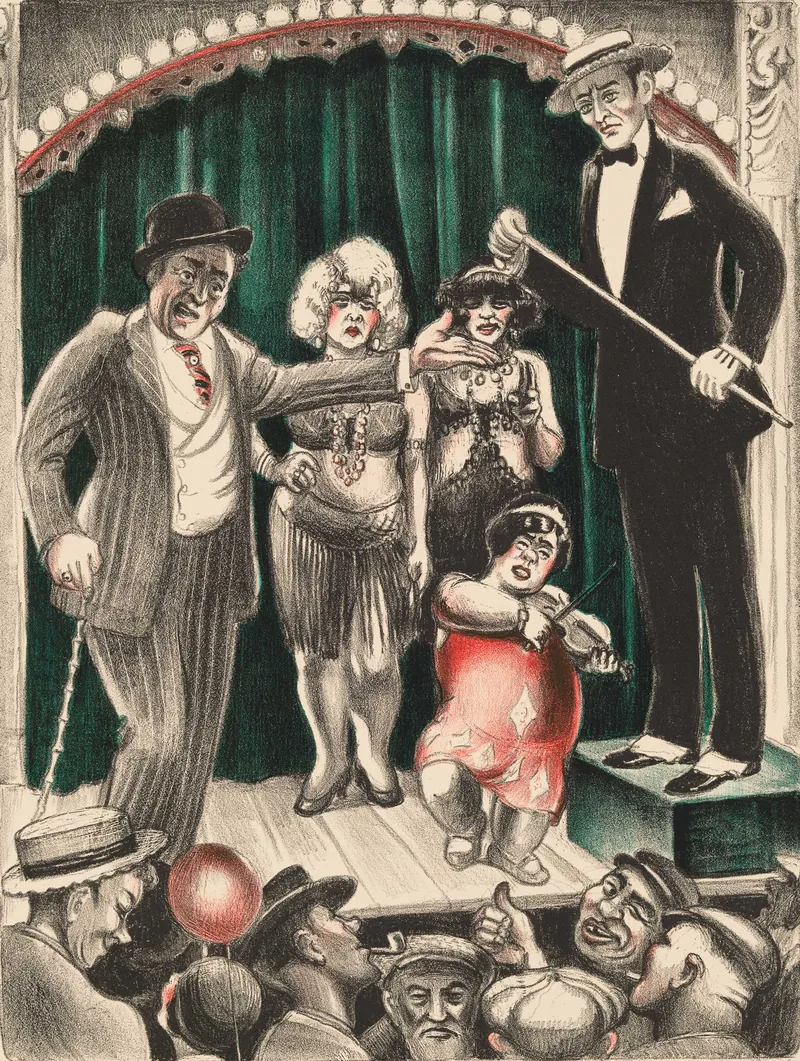
Mabel Dwight (1876–1955) wrote that keeping "a cool head and a warm heart" was essential to making art that would be a "living influence on the world." Dwight came to New York at the turn of the century as an illustrator and later fell in with the downtown artists who frequented the Whitney Studio Club, a precursor to the Museum. She ultimately found her voice in the swooping lines and seamless gradients of lithography. This democratic print medium became her primary vehicle for portraying her constant subject: the people and places of New York.
Dwight's self-described "socialist" vision of the world was of dignity across the socio-economic divides. Her crowd scenes depict individuals — usually rendered with a gently curving stroke, dramatic lighting, and delicate highlights — each taking part in a greater whole. Her intimate portraits offer uniquely expressive faces, and her overtly political images are as theatrical as her vision of the stage. All her subjects, whether selling balloons, strolling home, or waiting for the day to pass, possess the inner glow of what Dwight called "the stuff of life." The life in Dwight's prints came from her own — she spent her free time roaming the city, from Harlem to Staten Island, sketching in a notebook hidden inside her jacket. Back at her apartment, Dwight would revise her images and then carefully transfer them to a stone or a zinc plate, from which multiple impressions could be printed and inexpensively made available to the public.
Dwight's self-described "socialist" vision of the world was of dignity across the socio-economic divides. Her crowd scenes depict individuals — usually rendered with a gently curving stroke, dramatic lighting, and delicate highlights — each taking part in a greater whole. Her intimate portraits offer uniquely expressive faces, and her overtly political images are as theatrical as her vision of the stage. All her subjects, whether selling balloons, strolling home, or waiting for the day to pass, possess the inner glow of what Dwight called "the stuff of life." The life in Dwight's prints came from her own — she spent her free time roaming the city, from Harlem to Staten Island, sketching in a notebook hidden inside her jacket. Back at her apartment, Dwight would revise her images and then carefully transfer them to a stone or a zinc plate, from which multiple impressions could be printed and inexpensively made available to the public.
About the artist
Mabel Dwight
1875–1955
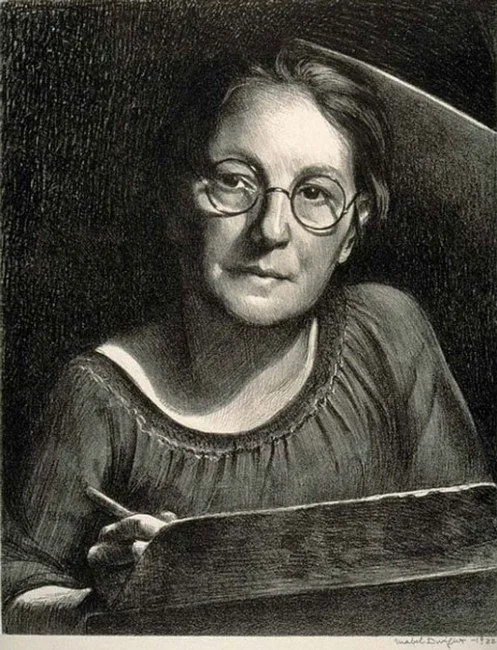
Mabel Dwight (1875–1955) was an American artist whose lithographs showed scenes of ordinary life with humor and tolerance. Carl Zigrosser, who had studied it carefully, wrote that "Her work is imbued with pity and compassion, a sense of irony, and the understanding that comes of deep experience."…
About the artist →About the venue

Whitney Museum of American Art
· New York
The Whitney Museum of American Art is a modern and contemporary American art museum in the Meatpacking District and West Village neighborhoods of Manhattan in New York City, New York, United States. The institution was founded in 1930 by Gertrude Vanderbilt Whitney, a prominent American socialite…