Now on
Memo Akten & Katie Hofstadter: The Thinking Ocean
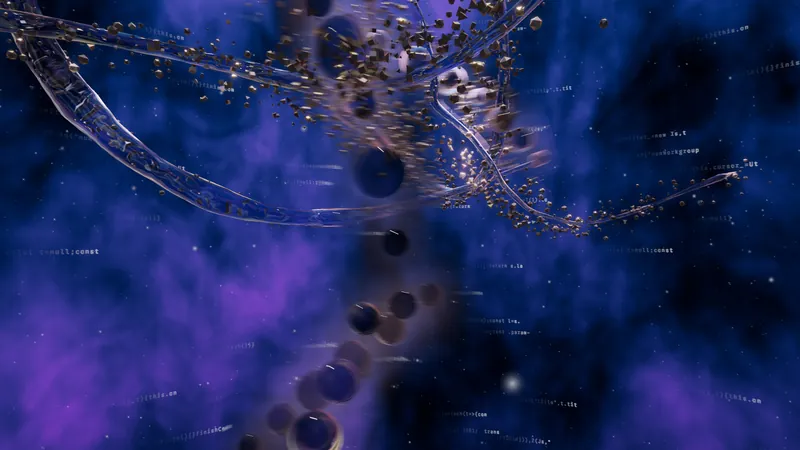
The shift between fluid dynamics and computation exposes oceans and computers as expressions of the same underlying principles—systems that can store and transmit information and flow. Recent research has shown that Navier-Stokes equations, which govern the movement of fluids like water and air, can in principle perform any computation that a digital computer is able to. The Thinking Ocean highlights our increasing bias toward granting agency to machines that mimic human behavior, while failing to notice the complex computations unfolding in natural systems surrounding us.
The work is accompanied by a voice reciting a non-linear poem that is dynamically generated in real time. Alexander Whitley contributed choreography, performance, and motion capture; Paige Emery created music and soundscapes; Niklas Niehus served as WebGPU consultant and developer; and Milana Aernova as studio assistant. Developed in dialogue with researchers at the Scripps Institution of Oceanography's SOARS Lab (Scripps Ocean-Atmosphere Research Simulator). The Thinking Ocean utilizes the WebGPU API, which requires iOS 26 or MacOS 26 or later on Apple devices.
About the artist
Memo Akten is a Turkish-born multidisciplinary artist, computer scientist and researcher. His work explores human machine entanglements through speculative simulations and data dramatizations, often engaging with themes of ecology, technology, spirituality, and collective intelligence. He serves as…
About the artist →Katie Hofstadter is an American artist, curator, and writer known for her interdisciplinary work at the intersection of technology, art, and performance. Her works often explore embodiment, consciousness, and the integration of artificial intelligence into creative practices.
About the artist →About the venue

The Whitney Museum of American Art is a modern and contemporary American art museum in the Meatpacking District and West Village neighborhoods of Manhattan in New York City, New York, United States. The institution was founded in 1930 by Gertrude Vanderbilt Whitney, a prominent American socialite…